Geometry in Algebra. Eversion.
Geometry in Algebra. Eversion.
Author: Stanislav Ivanov 🟢 0009-0004-1153-083X
Affiliation: InWho Foundation
Published: May 2026 · Version: 1.0
DOI:10.5281/zenodo.19979898
License: Creative Commons Attribution 4.0 International (CC BY 4.0)
Repository:Zenodo
Abstract
We propose an ontological framework for the formalism of quantum mechanics and special relativity, based on three principles: Conciliation (the projective work of bringing multiple perspectives into a single coherent state), Fluidity (the irreversible, anti-quantized continuity of process, identified with Time), and Eversion (an operator, denoted IW, which turns a structure inside out, generating a boundary between an inner and an outer domain).
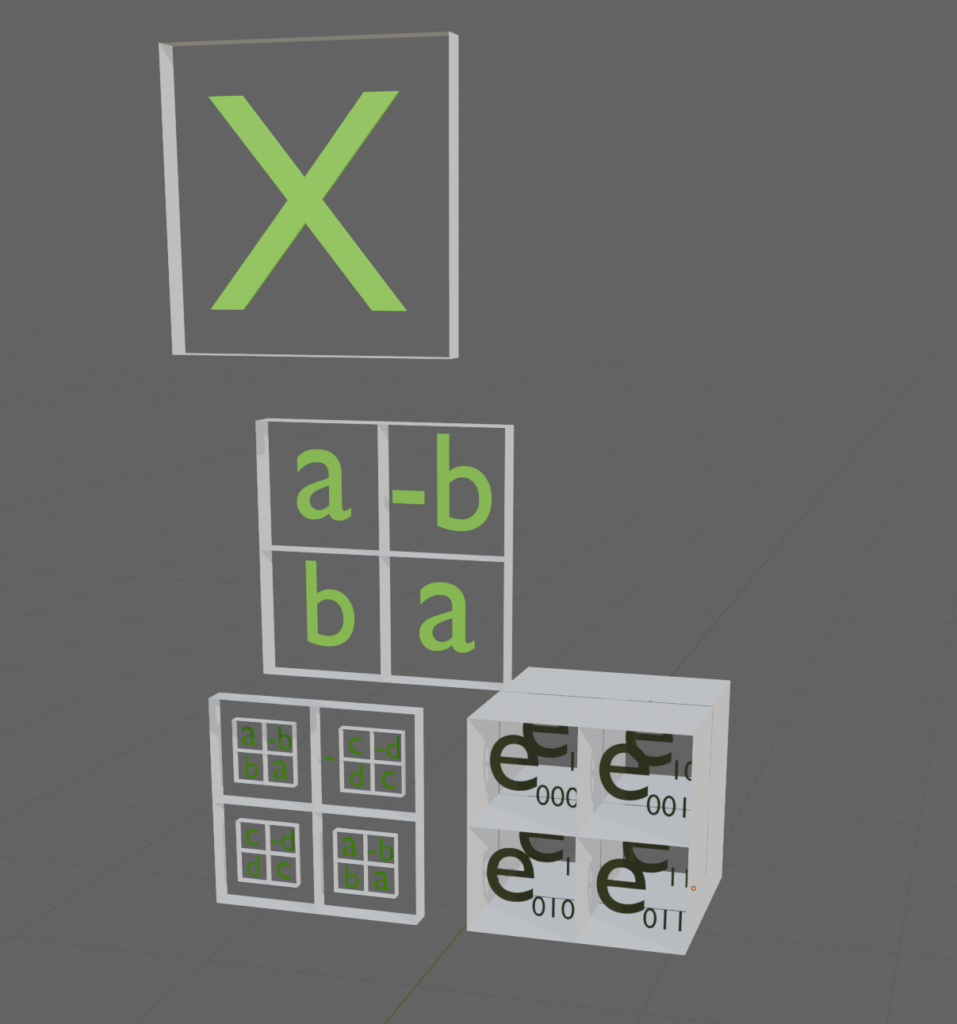
The framework yields several formal correspondences. The successive application of the Eversion operator generates the standard hierarchy of normed division algebras: ℝ → ℂ ≅ Mat(2 × 2, ℝ) → ℍ ≅ Mat(2 × 2, ℂ) (along the XY axis) and ℝ → ℂ → 𝕆 ≅ Mat(2 × 2 × 2, ℝ) (along the Z axis). The first branch is identified with the gauge groups U(1) and SU(2) of the electromagnetic and weak interactions; the second branch with SU(3) of the strong interaction, in which the multiplication law of the Fano plane appears naturally as a consequence of the rank-3 tensor structure (and explains the loss of associativity for octonions). On this basis SU(3) is more accurately represented as Mat(2 × 2 × 2, ℝ) than as Mat(8 × 8).
In the macroscopic limit the framework reproduces the Minkowski metric and the Lorentz transformations through quaternionic representation of spacetime, with the coefficient c interpreted as the rate of curvature of the Eversion of Time into Space. Mass acquires the form $$m^2 = T^2 – X^2$$. Dark matter and dark energy are interpreted as artifacts of incomplete Eversion of Matter and Space respectively. Spin ½, quantum entanglement, and the spherical wavefront of a photon receive natural geometric descriptions as projections of inner Eversion structures into observable space.
The framework is offered as a working ontology — a language in which the existing formalism of quantum mechanics becomes meaningful, and in which it extends naturally to a broader class of phenomena involving Conciliation between multiple perspectives.
Keywords: ontology of quantum mechanics, observer-dependent reality, octonions, Fano plane, SU(3), gauge groups, Minkowski metric, dark matter, dark energy, Eversion operator.
Introduction
We propose looking at Mathematical and Physical entities from one more angle.
We propose introducing 3 Principles: Conciliation, Fluidity, Eversion.
Principle 1 — Conciliation
Thanks to this principle, structures are brought into a common state. The meaning of this principle is to make every entity Singular, Unambiguous, Conciliated with everything else, a Solid Definite Comprehensible Meaning. Such an operation of Conciliation is impossible without “loss of quality.” Its Geometric Meaning is Projection. Its Physical meaning — reflection in a mirror. Its Informational meaning — taking an Address (and addresses are always discrete — that is how “quantization” appears). Roughly described in geometric terms: it is a rule that the sum of all projections onto a single, unambiguous common axis equals “1.”
$$\sum_{k=1}^{n} \langle \psi | e_k \rangle^2 = 1$$
It is important to note that the original structures themselves are far larger than their projections, and that the address of an object contains far less information than the object itself possesses.
This principle is clearly visible in quantum physics. Photons “live a free, almost unconstrained life” in superposition, but then this Principle of Conciliation requires them to make up their mind — they are either 1 or i. The same principle limits the number of electrons on each orbital of an atom. Even though electrons are not located at any specific point of the atom and are described by a probability sphere, they nonetheless have levels — and on each level, a limited number of seats. As if Ghosts could only sit two to a bench in a sauna.
Because for this Principle Conciliation matters more than “the absoluteness of facts,” paradoxes arise such as the “Wigner’s Friend” and the relativity of facts in quantum physics (the experiments of Proietti et al. (2019) and Bong et al. (2020) confirmed: the assumption of absolute, observer-independent facts is incompatible with the predictions of quantum theory).
As a result of this Principle’s manifestation, all dimensions, measurements, determinations, laws of physics, quantization, and so on appear.
In this sense, Quantum physics actually studies pre-quantum entities (it would be better to rename this Science to, say, “Divine” Physics 🙂 or, at the very least, the Physics of Time). And it describes the laws by which these entities are Conciliated with the quantum (countable) world. Because of this, quantum physicists keep getting the feeling that the world is essentially information; but we maintain that Information is only one of the levels of the Universe’s Being — the Level of Conciliation (our Coarse Material World). And in fact, even cause-and-effect connections are not so rigid and unambiguous. They merely Look / Are Conciliated as such (the beloved Maya / “Illusoriness” of Hinduism / Buddhism). Spatiality in physics belongs entirely to this Principle.
Historically, this Principle has been mentioned as the Logos, the Voice of God, Metatron. It is precisely this Principle that creates the highly structured, law-bound Jewish people (the Law, the 613 commandments) and the highly demanding Muslim world (Sharia, submission). In many events of the spiritual writings this Principle is clearly traceable — that which Structures, Crystallizes, creates Hierarchy, and so on.
Spoiler: the conflict between Nazis, Jews and Muslims is essentially merely an attempt by Conciliation to find out which of these three modes of Conciliation is the Strongest (most Hierarchical). If one uses only the first Principle without the second — conflict is inevitable.
(Here Nazism is meant not only as a political ideology, but as a maximally Conciliated Hierarchical society organized by the criterion of “Higher Race” — fully structured by the Principle of Metatron without the balance of Fluidity. In such a system, the leader structurally occupies the place of “God” — which is precisely why a personality cult is inseparable from totalitarianism.)
Principle 2 — Fluidity
It is Anti-Determined, Anti-Quantized. We feel it as Time (we are used to perceiving it as the “River of Life”). Why is Time a one-directional Dimension? Because it possesses a Different Essence. Space is defined by dimensionality, markings, coordinates (Conciliation). We want to treat the dimension of Time the same way — simply introduce coordinates: past, present, future. But Time is not a River — it is a Mountain of Sand. Time is an ordered list of Operands that have been applied to the objects of the material world. Time is a chronicler, a photographer who takes 3D photographs of space. And even if you find some operand that reverses some change — that operand simply gets added to the list of operations, and in this sense Time is irreversible. Time stores the list of Operands, not the “photographs” themselves. It somewhat resembles MPEG. The irreversible Increase of Entropy of the system is the “gravity” of Time.
Time is a Process, while Space / Matter is a Result.
$$T = {O_1, O_2, \ldots, O_n}, \quad O_k: \mathcal{M} \to \mathcal{M}$$
$$\mathcal{M}(t_n) = O_n \circ O_{n-1} \circ \cdots \circ O_1 \bigl(\mathcal{M}(t_0)\bigr)$$
$$\forall O^{-1}: \quad T \to T \cup {O^{-1}}, \quad |T| \nearrow \quad \text{(time grows, never shrinks)}$$
$$S\bigl(\mathcal{M}(t_{n+1})\bigr) \geq S\bigl(\mathcal{M}(t_n)\bigr), \quad \frac{dS}{dt} \geq 0$$
Where T is Time, M is the World, O are the Operands of Time.
Even this formula is not entirely accurate
$$T = {O_1, O_2, \ldots, O_n}, \quad O_k: \mathcal{M} \to \mathcal{M}$$
It looks as if “separate” operands exist = Quantization. But the Process of Fluidity is infinitely continuous. And only a “Glance” at it — that is, Conciliation — “Projects” it onto separate operands.
$$T = \int_{t_0}^{t} \mathcal{O}(\tau)\, d\tau \quad \text{(continuous Time = integral of Process)}$$
The quantized version is then a projection through Conciliation:
$$T_{\mathrm{quantized}} = \pi\left(\int_{t_0}^{t} \mathcal{O}(\tau)\, d\tau\right) = {O_1, O_2, \ldots, O_n} \quad \text{(Quantization = Conciliation projection)}$$
The connection between the two formulas:
$$\underbrace{\int_{t_0}^{t} \mathcal{O}(\tau)\, d\tau}{\text{Fluidity (continuous)}} \xrightarrow{\pi\ =\ \text{Conciliation}} \underbrace{{O_1, O_2, \ldots, O_n}}{\text{Quantization (discrete)}}$$
$$\boxed{\text{Time — integral. Quantization — projection of integral onto discrete axis.}}$$
Historically this Principle is called the Holy Spirit. It is the least named and least described entity. In the scriptures the Holy Spirit suddenly arrives, gives some kind of strength / knowledge / revelation, changes something, and just as imperceptibly leaves. In this sense, it is more accurate to perceive the Holy Spirit as all the Processes that exist within everything, everywhere, and between everything. But not as an object.
Obviously, without it nothing is possible. It binds everything together, gives everything “life” (as the right to change). All “boundaries” are “woven” out of it. And it balances “inside” versus “outside.”
In the Bible, for example, there is an unusual character “Satan,” whom the translators have wrongly designated as the enemy of God (which looks maximally contradictory). If one simply follows the translation and the processes described there, it becomes evident that this Function is the Prosecutor. That is, the one who maintains the Balance of “justice.” The later Latin translation “Devil” carries the same distortions.
Note: the genuine teaching of Christ — is the entry of the Second Principle (Fluidity / Love) into a world dominated by the First. The Crusades and the Inquisition — a return to pure Metatron without balance.
Any method of “Analysis” leads to the First Principle = Conciliation. Any method of “Synthesis” — to the Second = Fluidity. Therefore, when quantum physicists ask the question “where is the photon” — they are “cutting it down” through Conciliation. There is no observer effect here. Because the Principle of Conciliation itself, and its derivative — the Material “rigid” world — are themselves already “Observers”! The observer effect is not the mysticism of the subject, but the manifestation of the Principle of Conciliation as such.
Principle 3 — The Operand of Eversion (IW)
We propose introducing the Operand — Eversion (turning inside out, from Latin e-vertere) — denoted IW in our notation, which we keep as a reference to the underlying concept of InWho.
Some original structure “turns itself inside out” and a separation arises between inside and outside. Moreover, from the point of view of this structure, it is impossible to determine which part is the inside and which the outside.
Thanks to this Operand, Real numbers / scalars are everted into the complex — Mat(2 × 2).
$$\mathbb{R} \xrightarrow{IW} \mathbb{C} \cong \mathrm{Mat}(2 \times 2, \mathbb{R})$$
$$x \in \mathbb{R} \xrightarrow{IW} \begin{pmatrix} a & -b \ b & a \end{pmatrix}, \quad x = \sqrt{a^2 + b^2}$$
This is how we obtain the phase of the electromagnetic interaction U(1).
Here we have Mat(2 × 2), which gives us 4 degrees of freedom (4 real parameters), but we use only 2 of them — U(1). The “extra parameters” describe the fact that the Operand of Eversion does more than what we describe as a Complex number (see further: Artifacts of Eversion).
We emphasize that such an Operand of Eversion is more than mere Complexification.
Then each element of this matrix is everted within the same X*Y plane of the matrix.
$$\mathbb{C} \xrightarrow{IW} \mathbb{H} \cong \mathrm{Mat}(2 \times 2, \mathbb{C})$$
$$q = \begin{pmatrix} \begin{pmatrix} a & -b \ b & a \end{pmatrix} & -\begin{pmatrix} c & -d \ d & c \end{pmatrix} \ \begin{pmatrix} c & -d \ d & c \end{pmatrix} & \begin{pmatrix} a & -b \ b & a \end{pmatrix} \end{pmatrix}$$
This is how Quaternions are obtained.
Such a matrix turns out to be algebraically equivalent to Mat(4 × 4) — the properties of these two groups coincide (commutativity, associativity). Thus we obtain the Quaternions, but situated within Mat(4 × 4). That is, we actually have 16 degrees of freedom and the algebra can operate on them, but we use only 4 (see Artifacts).
This way we have obtained the Weak interaction SU(2). Moreover, it can also be described as Mat(2 × 2) of complex numbers.
$$q = \begin{pmatrix} \alpha & -\bar{\beta} \ \beta & \bar{\alpha} \end{pmatrix}, \quad \alpha, \beta \in \mathbb{C}, \quad |\alpha|^2 + |\beta|^2 = 1$$
Now, the eversion of a complex number as Mat(2 × 2) takes place along the Z axis — and we obtain a tensor of rank 3: Mat(2 × 2 × 2).
$$\mathbb{C} \xrightarrow{IW^Z} \mathbb{O} \cong \mathrm{Mat}(2 \times 2 \times 2, \mathbb{R})$$
This is the Strong interaction SU(3). For this tensor one can define a multiplication operation through the Fano transformation.
$$(\mathbf{A} \star \mathbf{B})k = A_0 B_k + A_k B_0 + \sum{\substack{i,j \geq 1 \ i \oplus j = k}} \mathrm{sgn}\bigl((i-j)(j-k)(k-i)\bigr) \cdot A_i B_j$$
And it is precisely the fact that the algebraic structure has become a tensor that explains why the associativity of the operation has been lost. The triple-rank tensor structure of the Fano transform suggests itself naturally, due to the XOR rule of coordinates eᵢ in the binary numeral system.
In our view, defining SU(3) as Mat(8 × 8) is inaccurate. Because Mat(8 × 8) preserves associativity. But for a tensor of rank 3 — it does not.
The general formula:
$$\mathbb{R} \xrightarrow{IW} \mathbb{C} \cong \mathrm{Mat}(2 \times 2, \mathbb{R}) \begin{cases} \xrightarrow{IW^{XY}} \mathbb{H} \cong \mathrm{Mat}(2 \times 2, \mathbb{C}) \ \xrightarrow{IW^{Z}} \mathbb{O} \cong \mathrm{Mat}(2 \times 2 \times 2, \mathbb{R}) \end{cases}$$
It turns out that the Weak and the Strong interactions are “brothers,” but ones that took different paths (XY vs Z).
Eversion creates a Boundary between “inside” and “outside.” And this Boundary / Transition demands an extremely careful treatment of algebra and physics. It is not simply a boundary like a wall — it is a change of arithmetic, of algebra, and of physics. As if we opened the door to a room and inside there is an entire universe (like the galaxy in the medallion of the cat Orion in the film Men in Black).
It is precisely in this sense that pre-quantum entities are located “inside,” while we are “outside.” That is why we have to introduce time as an imaginary dimension and renormalize all parameters. The next dive — into the Weak interaction, the quaternions — is essentially yet another transition inwards; while the Strong interaction — the Fano tensor — is another eversion (along the Z axis of the algebra of matrices / tensors). And this eversion is not from the Weak SU(2) but from the Complex U(1), only in a different way.
A Black hole is essentially an everted object, where the outer matter passes inwards. This self-eversion takes place in a linear, one-dimensional relation between Energy and space.
The speed of light is the boundary of the eversion of space / time. Upon reaching it, an object encounters the “resistance” of space and time. But upon overcoming the speed of light, the object finds itself inside (beyond the boundary of) space / time.
All these phenomena essentially describe how the structure was originally everted into our observable world. We calculate / Conciliate this process (in keeping with “shut up and calculate”) as the Big Bang.
This eversion is not perfect and has artifacts.
It seems that the artifacts of these eversions are what we call dark matter and dark energy. The first — the eversion of Matter (the “Gravity” of Gravity); the second — the eversion of Space (the “Spatiality” of Space).
Examples
For instance, spin ½ is easily described as an eversion into a Möbius strip.
$$\psi \xrightarrow{IW} \psi \cdot e^{i\varphi/2}, \quad \varphi \in [0, 4\pi) \quad \Rightarrow \quad \mathrm{spin} = \frac{1}{2}$$
$$e^{i \cdot 2\pi / 2} = e^{i\pi} = -1 \neq 1 \quad \text{(rotation } 360^\circ \text{ changes sign)}$$
$$e^{i \cdot 4\pi / 2} = e^{2\pi i} = +1 \quad \text{(rotation } 720^\circ \text{ returns)}$$
Long-distance action of entangled quantum particles is explained by the fact that they remain a single object “inside” space (in a subspace — in the science-fictional language of WARP-drives). Their projections into our space appear as two points.
$$d_{\mathrm{inner}}(A, B) = 0, \quad d_{\mathrm{outer}}(A, B) \gg 0$$
$$\partial\bigl({A, B}\bigr) = {A} \cup {B} \subset \mathbb{R}^3, \quad {A,B} \subset \mathbb{R}^{\mathrm{inner}}$$
Similarly, a photon flying from a point source is defined not by a line but by a sphere — because “inside” it is the eversion of a point into S², which is projected into our space as a wave front.
$${p} \xrightarrow{IW} S^2(ct) = {x \in \mathbb{R}^3 \mid |x| = ct}$$
$$\pi\bigl(IW(p)\bigr) = S^2(ct) \subset \mathbb{R}^3 \quad \text{(wave front)}$$
The elements of a Logical Binary (a pair of opposites) are not equal in scale. One of them is always inside, the other — outside.
Our “spatial” coordinates are essentially merely the address space of Conciliation (that is, Addresses that store “references” to matter). In this sense they are virtual / imaginary. They are essentially 3 phases along the real axis of Time.
$$\vec{r} = (x, y, z) \in \mathbb{R}^3 \cong \mathrm{Im}(\mathbb{H}), \quad t \in \mathbb{R}$$
$$q = \underbrace{t}{\text{real axis (Time)}} + \underbrace{xi + yj + zk}{\text{3 phases (Space)}}$$
$$\vec{r} = \mathrm{Im}(q), \quad t = \mathrm{Re}(q), \quad q \in \mathbb{H}$$
From here the Minkowski Metric and the Lorentz Transformations naturally emerge.
$$ds^2 = c^2 dt^2 – dx^2 – dy^2 – dz^2 = \mathrm{Re}(dq)^2 – |\mathrm{Im}(dq)|^2$$
$$|q|^2_{\mathrm{Mink}} = \mathrm{Re}(q)^2 – |\mathrm{Im}(q)|^2 = t^2 – (x^2 + y^2 + z^2)$$
These axes (i, j, k) do not run in straight lines but have a curvature (as a result of Eversion). At the beginning of Time (the Big Bang) they were “pressed” against the axis of Time, and over time they Straighten out with acceleration (space expands). The curvature of their bend is precisely our coefficient c (the speed of light). That is, roughly: c is the coefficient of the transition from time into space.
In Minkowski space, one can introduce light-like coordinates
$$u = ct + x, \quad v = ct – x$$
$$ds^2 = du \cdot dv$$
— coordinates along the light cones (null geodesics), rotated by 45° relative to (t, x). In these coordinates the metric takes its simplest form. Light rays move along
$$\text{light rays:} \quad u = \mathrm{const} \quad \text{or} \quad v = \mathrm{const}$$
In this sense, the “true” axes of space-time are the light cones, and our usual coordinates (t, x) are merely their rotated reflection.
The 45° angle between the axes (t, x) and the light cones (u, v) is not fixed from the start — it evolves from 0° at the moment of the Big Bang to 45° as space expands. The curvature of the bend of the axes (i, j, k) is precisely the coefficient c — the rate of transition from time into space.
$$c = \lim_{\Delta t \to 0} \frac{\Delta|\mathrm{Im}(q)|}{\Delta|\mathrm{Re}(q)|} = \frac{d|\vec{r}|}{dt}$$
$$\theta(t) = \arctan\left(\frac{|\mathrm{Im}(q)|}{|\mathrm{Re}(q)|}\right) = \arctan\left(\frac{|\vec{r}|}{ct}\right)$$
$$\theta(t) \xrightarrow{t \to 0} 0^\circ , \qquad \theta(t) \xrightarrow{t \to \infty} 45^\circ$$
$$\boxed{c = \frac{d\,|\mathrm{Im}(q)|}{d\,|\mathrm{Re}(q)|} \quad \text{- curvature of IW: transition rate from } t \text{ to } (x,y,z)}$$
The lines (curves) of the spatial axes (i, j, k) have Hausdorff dimension dim_H > 1.
$$\dim_H = \lim_{r \to 0} \frac{\log N(r)}{\log(1/r)}$$
$$1 \leq \dim_H(\text{axis}) \leq 3, \quad \dim_H = 1 \Leftrightarrow \text{straight line}, \quad \dim_H \to 3 \Leftrightarrow \text{space-filling curve}$$
$$\text{axis}(i,j,k) \xrightarrow{IW} \dim_H > 1 \quad \text{(curved by Eversion)}$$
$$\theta(t) \xrightarrow{t \to 0} 0^\circ , \quad \dim_H \xrightarrow{t \to 0} 1 \quad \text{(Big Bang: axes straight)}$$
$$\theta(t) \xrightarrow{t \to \infty} 45^\circ , \quad \dim_H \xrightarrow{t \to \infty} > 1 \quad \text{(now: axes curved)}$$
Our world (m, E) is essentially the difference between what Time has created and what Space has “eaten” from it (smeared out across space).
$$E^2 – |\vec{p}|^2 c^2 = m^2 c^4$$
$$m^2c^4 = \underbrace{E^2}{\text{created by Time}} – \underbrace{|\vec{p}|^2c^2}{\text{eaten by Space}}$$
$$q_{\mathrm{momentum}} = \frac{E}{c} + p_x i + p_y j + p_z k$$
$$|q_{\mathrm{momentum}}|^2_{\mathrm{Mink}} = \frac{E^2}{c^2} – |\vec{p}|^2 = m^2c^2$$
More sharply:
$$m^2 = \underbrace{E^2}{\text{Time}} – \underbrace{|\vec{p}|^2}{\text{Space}} = \mathrm{Re}(q)^2 – |\mathrm{Im}(q)|^2$$
$$m^2 = E^2 – p^2$$
$$s^2 = t^2 – x^2$$
$$\boxed{m^2 = T^2 – X^2}$$
Why are the distances between atoms and electrons (in the obsolete Bohr model) so large? Why is space practically Empty and even light takes years to reach the nearest star? Because we are asking the wrong one! We are asking the fisherman: “how big a fish did you catch?” He is guaranteed to exaggerate! We are asking Space: “where is the matter?” We need to ask Time!
Epilogue
Modern physics has no working ontology for its own formalism of quantum mechanics. We propose a language in which this formalism becomes meaningful. This language works not only for quantum physics, but for an entire class of phenomena in which Conciliation between the perspectives of multiple observers is at work — from psychotherapy to social dynamics.
Further descents of physicists into the Structure of the World will lead to the discovery of further Eversions. We have proposed a Geometry within Matrices / Algebra. Simply look for the next transitions.
We invite the Scientific community to mathematize these Entities.
How to cite this work
Ivanov, S. (2026). Geometry in Algebra. Eversion: An Ontological Framework for Quantum Mechanics and Special Relativity (1.0). InWho Foundation. https://doi.org/10.5281/zenodo.19979898
BibTeX:
@misc{ivanov2026eversion,
  author       = {Ivanov, Stanislav},
  title        = {Geometry in Algebra. Eversion: An Ontological Framework for Quantum Mechanics and Special Relativity},
  year         = {2026},
  month        = {may},
  howpublished = {InWho Foundation},
  doi          = {10.5281/zenodo.19979898},
  url          = {https://doi.org/10.5281/zenodo.19979898},
  orcid        = {0009-0004-1153-083X}
}
Leave a Reply